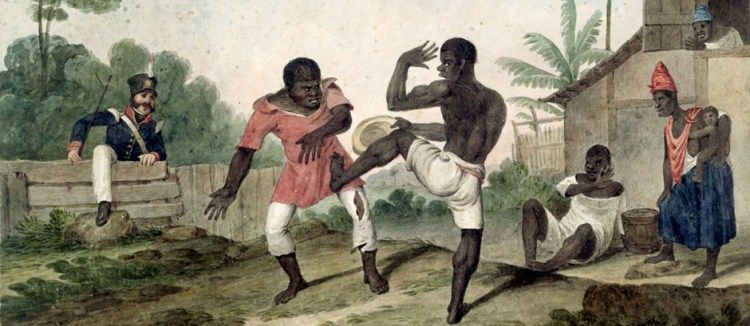
CAPOEIRA (Ca-poh-eh-ra) is a unique art form that is rooted in the brutal history of people enslaved in Brazil. Capoeira’s origins are a confluence of the cultural traditions of East and West Africans and native Brasilians. While there are historical tellings of Capoeira, or something similar, being played on the plantations by the enslaved, the emerging school of thought is that the art became established in the wake of the aboliton of slavery in Brasil in 1881. Newly “freed” people found themselves without work and often living a rough existence, attempting to form communities and secure their well-being. A shared love of music inspired dancing and story-telling, the comraderie they felt inspired play, and the colonial aggression they still experienced inspired self-defense. Capoeira was born.
At first glance, Capoeira looks like a complicated choreographed dance between two people that involves a seamless combination of circular movements synced to rhythmic music and songs. Similar to other martial arts, Capoeira is an improvised and strategic game of questions and answers, call and response. It is a dialogue between two players where movements represent the words of the language. The challenge lies not only in the ability to form fluid sentences with these movements, but to engage in a conversation with your partner.

The field of play is called the Roda (pronounced HOH-dah). The roda is a circle formed by spectators and the orchestra. Two capoeiristas enter the Roda and play a capoeira game which is dictated by the musical rhythm being played by the orchestra. The game finishes when one of the musicians holding a berimbau calls it to end, when one of the capoeiristas decides to finish the game, or when one of the players is replaced by another player who effectively continues the game, or starts a new one.
The basic stance of Capoeira is the ginga (JING-gah). The ginga is a dynamic stance where one moves from a lunge-like position on one side, to a lunge-like position on the other side. The hands are used to maintain balance as well as to protect the face from any strikes towards the head. Everything originates from the ginga.
The main types of offensive movements are round kicks and straight kicks, while movements called esquivas are used to dodge kicks, as opposed to block kicks. Esquiva literally translates as “dodge”. The game of Capoeira is a dialogue of attacks and counterattacks, punctuated with floreios. Floreios, or flourishes, are the acrobatic movements of the game. The beauty of Capoeira is that it flows from a flurry of kicks to artful acrobatics back to a flurry of kicks, without missing a beat. More advanced and agile Capoeiristas often use floreios to challenge each other in a can-you-do-this kind of game where they try to out-do each other with breath-taking acrobatics.
The uniqueness of Capoeira is the importance of music. The focal point of any game is the orchestra, which can consist of anywhere from one to six instruments, depending on the school. The Camará bateria is ideally made of seven instruments, three berimbaus (bow-shaped attached by a string loop to a gourd), one atabaque, two pandeiros (tambourine) and an agogô (handheld wooden percussion instrument). The berimbau dictates the type of game that is to be played through different toques or rhythms: Angola, São Bento Grande and Benguela are the most common rhythms. Each rhythm can be played fast or slow. Each rhythm dictates a specific type of game with its own set of unwritten rules, rituals or traditions. Each game can develop from a seeming friendly, cooperative game to an aggressive fight.
In order to advance to the higher levels of Capoeira, one must also become adept at playing each of the instruments, playing any of the rhythms, and leading the Roda in song. Through singing, the Capoeiristas who form the Roda provide energy for the game that is being played within. Energetic singing fuels the players and helps them to elevate their game. Playing Capoeira without the participation of the spectating capoeiristas would be like a professional hockey game without the fans.
Capoeira celebrates grace, fluidity, strength, and expression. As for the children, they are not taught the fighting aspects of Capoeira until they have matured and have developed a solid understanding of the cooperative game of call and response. Capoeira is the whole package – exercise for the mind, body and soul.
Thanks to one of the founding Capoeira Camará students Monitora Sorriso for the above information and the amazing write-up! Edited in 2022 by Monitora Sorriso & Valentia of Capoeira Camará (Toronto, Canada)

Capoeira Camará Toronto
Railpath Arts Centre
35 Golden Ave #108
Toronto, ON


Copyright © Capoeria Camará 2022. All Rights Reserved.
 Capoeira Camarà Toronto